





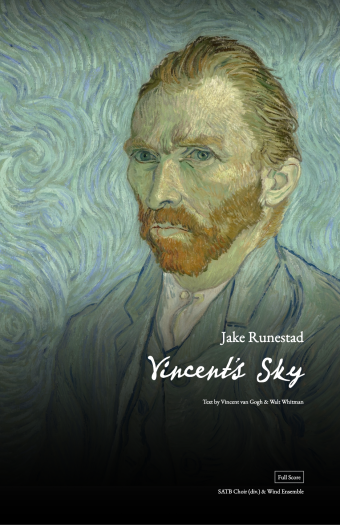


Description:
Contact Jake at www.jakerunestad.com for part rental information.
Performance Video:
Background
Vincent van Gogh’s story is often framed by struggle—his lack of recognition, his illness, and the myths that surround his life. Yet, beyond the shadows, Vincent lived with a luminous heart: he gave generously to those in need, loved with intensity, and uncovered beauty in the ordinary. Though he endured what many now believe was temporal lobe epilepsy, his greatest gift was his vision—teaching us to see the world with fresh eyes, alive with light and wonder.
Across the ocean, Walt Whitman sang with a similar spirit. Vincent read him with admiration, and one senses in his letters and paintings a kinship with Whitman’s voice. Both were largely self-taught, both were seekers of truth and beauty, both revealed through their art a profound tenderness for people and the natural world. In Whitman’s words, Vincent may have found a companion; in Vincent’s colors, we may glimpse Whitman’s song.
In Vincent’s Sky, I explore van Gogh’s emotional world through the lens of three of his paintings, guided by Whitman’s words. I used a musical cryptogram, assigning pitches to letters, to spell words that would inform the musical content. For example, “VINCENT” is spelled with the notes A, B, G, C, E, G, F.
I. Olive Trees
This painting pulsates with yellow rays emanating from the sun over a field of olive trees. Vincent associated yellow with happiness, and Whitman’s text for this movement celebrates color and light.
II. Wheatfield with Crows
While this movement opens with a soaring admiration for the beauty of the earth, Vincent’s thoughts are soon overtaken by hallucinations, ghostly voices, and chaos. The dark, stormy sky and presence of crows (a symbol of death) foreshadow difficulties ahead. Vincent wrote in his letters about having hallucinations of the Horla during his psychotic episodes. The Horla, a story written by Guy de Maupassant in 1886, depicts the possession of the main character by a supernatural being after he waved to a “superb three-mast ship,” and how this being gradually takes over his mind.
III. The Starry Night
Vincent’s most iconic painting of the night sky is adapted from the view from his bedroom window at the Saint-Paul Asylum in Saint-Rémy-de-Provence where he admitted himself after a severe mental health crisis. Vincent’s fight against the “silent shadows” of his inner world come to life in the beauty of this night scene, in which the sky swirls with color and the stars shimmer with light. Whitman’s words bring us the hopeful twinkling of the stars in the face of life’s darkness.
Number of Pages: 46
Format: Octavo