






Abbington, James
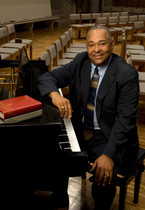
Wilbur James “Jimmie” Abbington, Jr., a distinguished church musician, educator, and scholar whose influence on African American sacred music reached across generations, was born on April 15, 1960, to Wilbur and Daisy Ann Abbington, in Gary, West Virginia, a small U.S. steel coal-mining town that nurtured his earliest love for music and worship. In his own words, Gary was a community that “had very high standards for worship and music,” and it was there that his mother first introduced him to piano progressions at the age of five. That early training, together with the traditions of the Pentecostal church (into which he was baptized and saved at an early age) shaped a musician whose gifts quickly became undeniable.
Abbington often credited the late Dr. Wendell Phillips Whalum of Morehouse College as being his greatest mentor. After an initial start at West Virginia State College, Abbington transferred to Morehouse College, where under Whalum’s guidance he matured musically and spiritually. At Morehouse, he developed a passion for the organ and a commitment to excellence in worship that would define his career. He graduated with a Bachelor of Arts in 1983. During these years, Abbington served as organist at West Hunter Street Baptist Church under Rev. Ralph David Abernathy, and later as associate organist and choir director at Ebenezer Baptist Church, still shepherded by Rev. Martin Luther King, Sr. Abbington cherished Rev. King’s advice to embrace scholarship while never forgetting the roots of African American worship traditions. That grounding, coupled with Abbington’s studies, would shape a career devoted to bridging heritage and academic rigor.
Abbington pursued graduate studies at the University of Michigan, Ann Arbor, earning the Master of Music in 1995 and the Doctor of Musical Arts in 1999, where he studied with Marilyn Mason. While in Michigan, he also served as organist, choir director, and lay minister of music at Hartford Memorial Baptist Church in Detroit, where the Reverend Dr. Charles Adams encouraged him to deepen his theological foundation. Adams even arranged for Abbington to pursue independent study at Harvard, ensuring he integrated biblical and pastoral insight with his musical training.
His academic career was distinguished. He served as professor of music at Morgan State University (1998–2003), associate professor of music and director of the Concert Choir at Shaw University (2003–2006), and for nearly two decades as associate professor of church music and worship at the Candler School of Theology, Emory University (2006–2025). He also taught as adjunct professor of church music at Morehouse College and as visiting professor of Christian hymnody at Yale University’s Institute of Sacred Music.
In 2025, Abbington reached a pinnacle of recognition when Duke Divinity School appointed him the inaugural Joseph B. Bethea Professor of the Practice of Sacred Music and Black Church Studies. The endowed chair, established through a $5 million gift from The Duke Endowment, was designed to strengthen Black Church studies and theological formation. Dean Edgardo Colón-Emeric hailed Abbington as “a wonderful addition to our faculty and the broader Duke community,” affirming his appointment as a landmark moment for both Duke and the wider church.
Beyond the classroom, Abbington was a prolific editor and author. His publications include Let the Church Sing On! Reflections on Black Sacred Music (2009), Readings in African American Church Music and Worship (2001), and Let Mt. Zion Rejoice! Music in the African American Church (2001). He co-authored worship resource volumes (Waiting to Go! 2002; Going to Wait! 2003), edited Wyatt Tee Walker’s Spirits That Dwell in Deep Woods (2003), and advanced organ repertoire through King of Kings: Organ Music of Black Composers, Past and Present (2008–2009). His discography includes Use Me (2008), Beams of Heaven (2006), and How Excellent Is Thy Name (2004), along with several collections drawn from the African American Heritage Hymnal.
Abbington also served as Executive Editor of the African American Church Music Series at GIA Publications for more than 25 years, ensuring that the music of African American composers would find its rightful place in churches and concert halls. He was co-director of music for the Hampton University Ministers’ and Musicians’ Conference, where in 2010 the Choir Directors’-Organists’ Guild named their Church Music Academy in his honor. He also served as national director of music for both the Progressive National Baptist Convention and the NAACP, extending his reach across communities nationwide. He was the minister of music and church organist at Friendship Baptist from 2012-2025.
His scholarship and talents earned him recognition as a Fellow of The Hymn Society of the United States and Canada, the organization’s highest honor. He was only the second African American to ever receive this honor. His research and teaching—spanning African American sacred folk music, organ, choral repertoire, and ethnomusicology—have shaped the study and practice of worship for decades.
To students, colleagues, and congregations alike, Dr. Abbington was a teacher, mentor, and example of how music could both honor heritage and serve the living church. True to Rev. King’s charge, he never forgot how to play “Amazing Grace” in the way his community sang it. In that vein, he uniquely fused his Pentecostal roots into public performance and scholarship, and in recent years he conducted extensive research on the music of that church tradition.
His life’s work connected scholarship, tradition, and passion for sacred music and worship in service to God and God’s people. It was that unique blend that led to Abbington’s being highly sought-after as a guest director, organist, and clinician for many of the nation’s major church congregations and universities. He directed choirs in performance with both the Dallas and Detroit symphonies. Yet, Jimmie would still visit a small church and share his talents, and he did it with the same passion that he brought to major venues. As Kipling once wrote, Jimmie could walk with kings, but not lose the common touch.
Dr. Abbington passed into eternal life on September 27, 2025. His legacy will live on in the countless lives he touched, the choirs he led, the hymns he preserved, and the students he inspired and mentored to connect music, theology, and worship.